
10 Red Flags of FMLA Fraud Every HR Manager Should Know
The Family and Medical Leave Act (FMLA) is a cornerstone of employee rights, providing essential job-protected leave for qualifying family and medical reasons.
The vast majority of employees use this leave responsibly. However, a small percentage exploit the system through fraudulent claims, creating significant operational and financial burdens for employers.
For human resources managers and risk professionals, particularly in key economic hubs like Ohio, Kentucky, and our expansion markets of Dallas and Houston, identifying the warning signs of FMLA abuse is a critical skill.
Recognizing these red flags early can help you protect your organization, ensure fairness for all employees, and maintain the integrity of your leave programs.
This article, written from the perspective of licensed private investigators, outlines the top 10 red flags of FMLA fraud that every HR manager should recognize.
Furthermore, we will explore the nuances of FMLA abuse versus outright fraud, the new challenges presented by remote work, and when it becomes necessary to engage professional investigators.
The High Cost of FMLA Fraud: More Than Just Lost Productivity
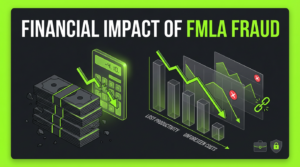
FMLA fraud extends far beyond the direct cost of an absent employee.
The indirect costs can be even more damaging, creating a ripple effect across the organization.
When one employee abuses the system, it often leads to decreased morale among colleagues who must shoulder the extra workload. This can foster resentment and a decline in overall team productivity.
Moreover, fraudulent claims can lead to increased administrative burdens, higher insurance premiums, and potential legal costs if the situation is mishandled. According to the Society for Human Resource Management (SHRM), unscheduled absenteeism costs employers an estimated $3,600 per year for each hourly worker and $2,650 each year for salaried employees.
When that absenteeism is fraudulent, the financial impact is compounded by a breakdown in workplace trust.
Understanding the Difference: FMLA Abuse vs. FMLA Fraud
Before diving into the red flags, it is crucial to distinguish between FMLA abuse and FMLA fraud.
FMLA abuse typically involves an employee using their approved leave for purposes other than intended, such as taking a day off for personal errands when they have intermittent leave for a chronic condition.
While problematic, it may not involve deliberate deception. FMLA fraud, on the other hand, involves willful deceit to obtain leave.
This can include falsifying medical documents, misrepresenting a medical condition, or working a second job while on leave.
The legal distinction is important, as proving fraud often requires a higher burden of proof and can lead to more severe consequences, including termination and legal action.
Top 10 Red Flags of FMLA Fraud
Based on our experience conducting corporate investigations across the Midwest and in major metro areas, certain patterns of behavior consistently emerge in cases of FMLA fraud.
Here are the ten most common red flags every HR manager should be trained to identify.
1. The “Friday-Monday Leave Act”: A Pattern of Suspicious Absences
One of the most classic signs of potential FMLA abuse is a consistent pattern of absences that conveniently extend weekends or holidays. If an employee’s intermittent leave for a chronic condition almost always falls on a Monday or a Friday, it warrants a closer look. While legitimate flare-ups can occur at any time, a recurring pattern that suggests a desire for long weekends is a significant red flag. This is often the first indicator that prompts employers to scrutinize an employee’s leave usage more carefully.
2. Leave Requests Following Disciplinary Action
An employee who suddenly requests FMLA leave immediately after receiving a poor performance review, a written warning, or being placed on a performance improvement plan should raise a flag. In some cases, the leave request is a legitimate response to stress or a newly developed medical condition. However, it can also be a tactic to avoid accountability, delay termination, or build a case for a retaliatory discharge claim. The timing of the request, in conjunction with other factors, is a key piece of the puzzle.
3. Contradictory Information from Social Media or Other Sources
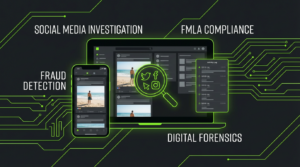 In the digital age, social media has become a powerful tool for uncovering FMLA fraud. An employee on leave for a serious back injury who posts photos of themselves on a ski trip, or an individual on leave for anxiety who is tagged in photos at a crowded concert, is providing direct evidence that contradicts their medical claim. While a single post may not be conclusive, a pattern of activity inconsistent with the stated reason for leave is strong evidence that warrants further investigation. Professional investigators are skilled at ethically and legally gathering this type of open-source intelligence.
4. Vague or Inconsistent Medical Certifications
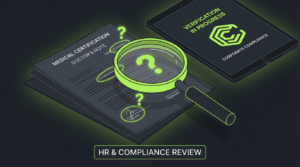 Employers have the right to request a medical certification to support an FMLA leave request. Vague, incomplete, or suspicious-looking certifications are a major red flag. Look for certifications that lack a clear diagnosis, provide a generic description of the condition, or come from a medical provider whose specialty does not align with the stated illness (e.g., a podiatrist certifying a psychiatric condition). Under the FMLA, employers can seek clarification or even a second or third medical opinion if they have reason to doubt the validity of a certification [3].
5. Unwillingness to Cooperate or Provide Details
While employees have a right to privacy, a complete refusal to provide necessary information or cooperate with the certification process can be a sign of a fraudulent claim. An evasive employee, who provides conflicting information or becomes hostile when asked for standard documentation ,may be trying to hide something. Legitimate claimants are typically willing to provide the necessary information to have their leave approved.
6. Reports of Second Jobs or Conflicting Activities
One of the most blatant forms of FMLA fraud is working a second job while on leave. This is particularly common in cases where an employee claims they are unable to perform their primary job duties but is found to be working a similar or even more physically demanding job elsewhere. Surveillance is often the most effective method for documenting this type of fraud, providing irrefutable evidence of the employee’s activities.
7. A Spike in Intermittent Leave Without Clear Reason
Intermittent FMLA leave is one of the most challenging types of leave to manage and one of the most susceptible to abuse. A sudden and unexplained increase in the frequency or duration of intermittent leave, especially without a corresponding change in the employee’s medical condition, is a significant red flag. For example, an employee who previously took one day of intermittent leave per month and suddenly begins taking two days per week may be abusing the system.
8. Employee Cannot Be Reached During Leave
While an employee on FMLA leave is not required to be on call, a complete inability to reach them for an extended period can be suspicious. If an employee is consistently unreachable, does not return calls or emails, and has provided no emergency contact information, it may indicate that they are not where they claim to be. This is particularly relevant if the reason for leave would not typically render someone completely incommunicado.
9. Miraculous Recoveries and Convenient Relapses
Be wary of employees whose medical conditions seem to miraculously improve the moment a major project is due or a difficult shift is scheduled, only to relapse as soon as the pressure is off. This pattern of convenience suggests that the leave is being used to avoid work rather than to manage a legitimate medical condition. Tracking these patterns over time can help build a case for suspected abuse.
10. Tips from Coworkers or Anonymous Sources
Coworkers are often the first to notice signs of FMLA abuse. They may see incriminating social media posts, hear the employee bragging about their “vacation,” or have direct knowledge of fraudulent activity. While you must handle these tips with care to avoid creating a toxic work environment, they should not be ignored. An anonymous tip can be the catalyst for a formal investigation, providing the initial lead that a professional investigator can then substantiate with concrete evidence.
The Remote Work Complication: New Challenges in FMLA Fraud Detection
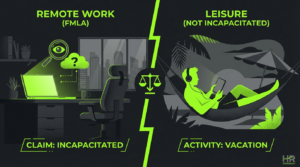 The rise of remote work has introduced new complexities to FMLA fraud detection.
It is more difficult to observe an employee’s behavior when they are not physically present in the workplace. An employee may claim they are too ill to work from their home office, yet be perfectly capable of performing their duties.
In these cases, digital forensics and sophisticated surveillance techniques may be necessary to determine if an employee is truly incapacitated or simply taking advantage of the lack of direct supervision.
When Red Flags Aren’t Enough: The Role of Professional Investigation
Identifying red flags is the first step. However, suspecting fraud and proving it are two different things.
An internal investigation conducted by HR can be fraught with legal risks, including claims of retaliation or invasion of privacy.
This is where a licensed private investigation firm like Gravitas Investigations becomes an invaluable partner. Professional investigators are trained to gather evidence in a legal and ethical manner, using techniques such as:
- Surveillance: To document an employee’s activities and physical capabilities.
- Background Checks: To uncover undisclosed second jobs or other conflicting information.
- Social Media and Open-Source Intelligence: To gather digital evidence of fraudulent activity.
- Witness Interviews: To discreetly gather information from relevant parties.
By engaging a professional, you create a layer of separation that protects your organization and ensures that the investigation is conducted impartially and in accordance with all applicable laws, including those in Ohio, Kentucky, Indiana, and our expansion markets of Texas, New York, and Illinois.
Your Partner in Protecting Your Business
FMLA fraud is a serious issue that can have a significant impact on your bottom line and workplace culture. By training your HR team to recognize these ten red flags, you can take a proactive approach to mitigating risk. When you have a reasonable suspicion of fraud, partnering with a professional investigation firm is the most effective way to gather the evidence you need to take decisive and legally defensible action. Gravitas Investigations has the experience and expertise to help you navigate these complex situations and protect the integrity of your business.
If you have identified several of these red flags and suspect FMLA fraud in your organization, contact Gravitas Investigations today for a confidential consultation.

